HD Hyundai Marine Solution Successfully Completed its First LNG FSU Conversion — Pioneering a New Era of Environmentally Friendly Retrofit Solutions
▶ Conversion of LNG Carrier to FSU for Use as an LNG Receiving Terminal in Central America
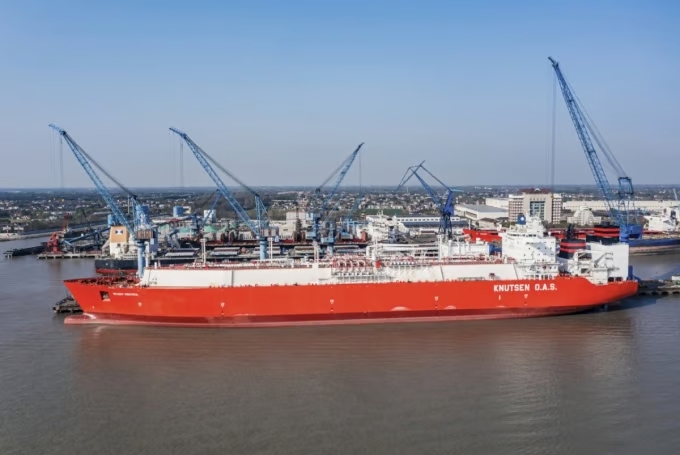
HD Hyundai Marine Solution (“HMS”), a comprehensive marine solutions subsidiary of South Korea’s HD Hyundai Group, announced the successful completion of its first LNG FSU (Floating Storage Unit) conversion project, marking a significant milestone in its environmentally friendly retrofit capabilities. The project was awarded by a European shipowner in July of last year.
An LNG FSU serves as a stationary floating LNG terminal that receives and stores liquefied natural gas from LNG carriers and supplies it to onshore power plants or storage facilities. Converted from an LNG carrier, the FSU offers the flexibility to relocate based on market demands or weather conditions, making it an economical, flexible, and environmentally friendly solution in the global energy sector.
HMS provided a comprehensive turnkey solution for the project, covering engineering, procurement, installation, and commissioning. The project involved converting a 138,000 cbm LNG carrier, originally built at a Spanish shipyard in 2004, into an LNG FSU. In partnership with the shipowner and shipyard, HMS successfully completed equipment installation and onboard commissioning at a Chinese shipyard.
LNG FSU conversions require advanced technical expertise due to the absence of standard designs, underscoring HMS' accumulated know-how and competitive edge in environmentally friendly retrofit projects.
The successful delivery of HMS' first LNG FSU conversion project serves as a solid foundation for the company's expansion into FSRU (Floating Storage and Regasification Unit) conversions and other large-scale retrofit projects aimed at enhancing environmental sustainability—initiatives currently under discussion with its various global clients.
The newly converted LNG FSU will be stationed at a port in Central America, where it will supply natural gas to a nearby power plant, contributing to the region's stable and sustainable energy supply.