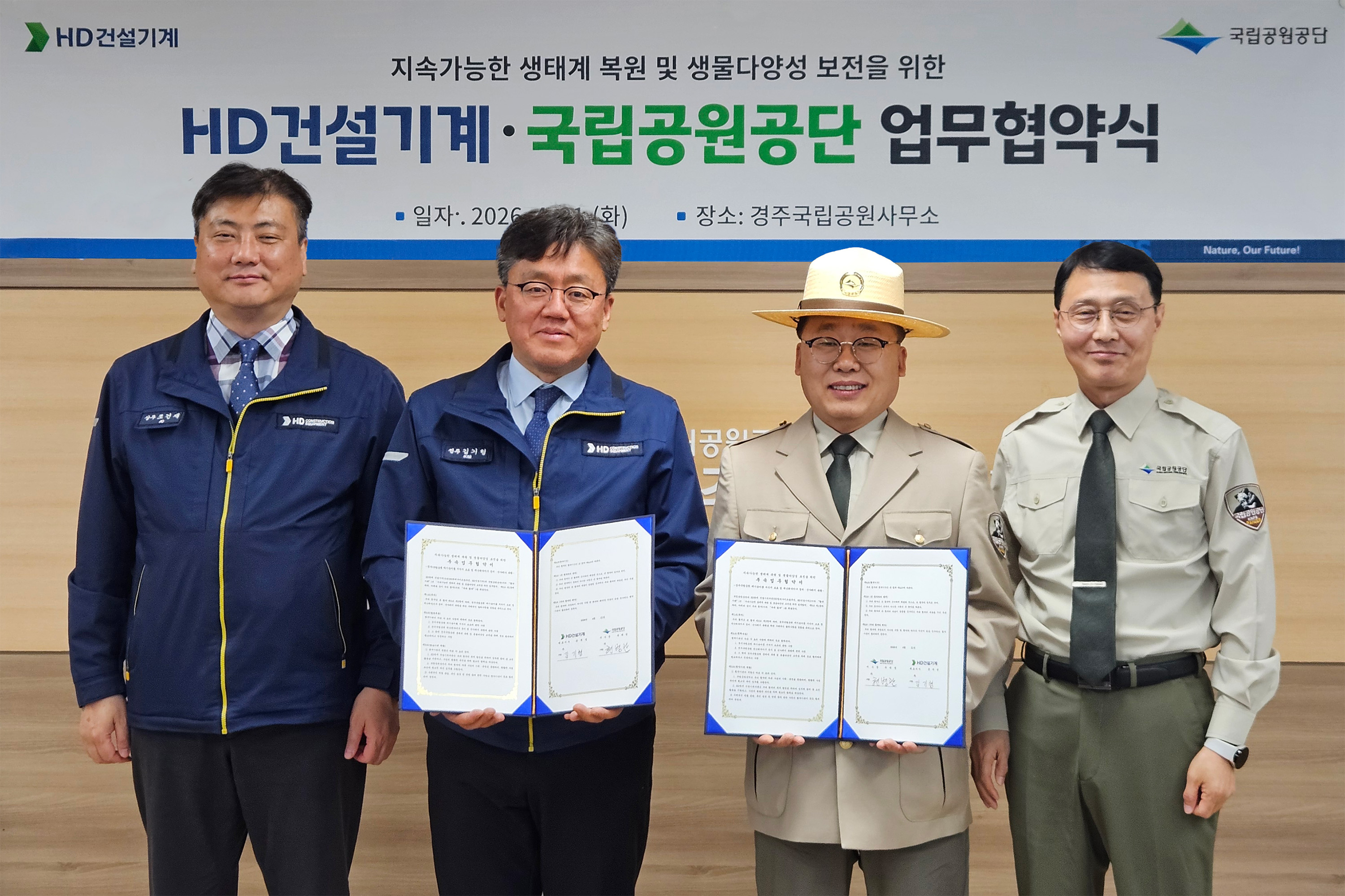
▶ Agreement to restore sustainable ecosystems and conserve biodiversity in Gyeongju National Park.
▶ Powering sustainable change with financial support and employee participation.
HD Construction Equipment is joining forces with the Korea National Park Service (KNPS) to conserve biodiversity, including the protection of endangered species in Gyeongju National Park.
The company announced on Thursday, the 23rd, that it recently signed an "Agreement for Sustainable Ecosystem Restoration and Biodiversity Conservation" with the KNPS at the Gyeongju National Park Office.
Under this agreement, the two parties plan to promote: ▲Protection activities for the radical-flower lousewort, a species native to Korea; ▲Habitat management and monitoring of endangered species; and ▲Maintenance and restoration of disaster-vulnerable areas.
The radical-flower lousewort is an indigenous species found on the Korean Peninsula, thriving in cool valley regions. It is classified as "Vulnerable (VU)" on the International Union for Conservation of Nature (IUCN) Red List. Its habitat is increasingly threatened by climate change and a growing number of visitors.
HD Construction Equipment will provide project funding and organize employee volunteer activities, while the KNPS will oversee the entire project, including site selection, habitat protection, and ecosystem restoration.
Building on a successful partnership that began in 2023 with the restoration of the Uiryeong Trail in Bukhansan National Park, the company is now extending its conservation efforts to Gyeongju National Park, conveniently located near its Ulsan Campus.
An official from HD Construction Equipment stated, "Through this agreement, we aim to establish a foundation for the long-term conservation and sustainable management of the Gyeongju National Park ecosystem. We plan to implement various environmental conservation measures that will significantly benefit the local community."
Ahead of the signing ceremony, 30 Ulsan Campus employees gathered on the 15th to help create a nature-friendly landscape by planting native trees, supporting the ecological restoration of a former gravesite in the Tohamsan district of Gyeongju National Park.