While electric vehicles (EVs) have successfully entered the mainstream, the electrification of large-scale vessels remains a formidable challenge. Unlike passenger cars, large commercial vessels must transport tens of thousands of tons over vast distances for weeks at a time without the possibility of mid-voyage recharging. This necessitates not only massive energy storage solutions but a fundamental redesign of the ship’s propulsion architecture.
To resolve such issues, the shipbuilding industry is exploring solutions that use electricity generated from clean energy sources such as hydrogen, natural gas, and ammonia to power propulsion motors. This approach significantly reduces greenhouse gas emissions while also minimizing vibration and noise.
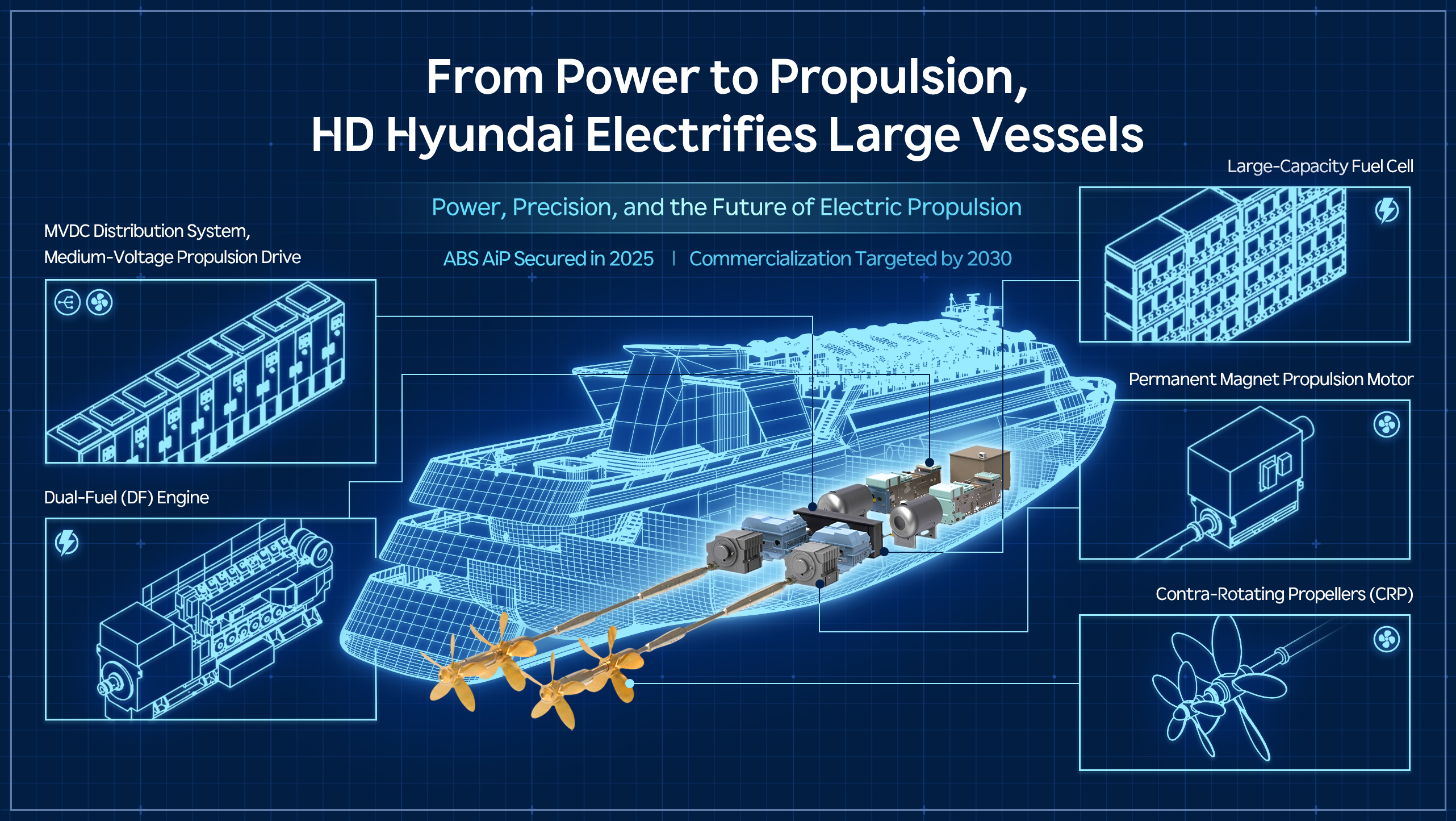
Electrification has three phases: power generation, distribution and conversion, and propulsion.
Power Generation for Electric-Powered Ships: Energy Mix
HD Hyundai is expanding the development and application of its “energy mix power system,” which combines dual-fuel engines (DFGE) with ammonia-based solid oxide fuel cells (SOFC).
DFGE offers flexibility in responding to fluctuations in power demand. During vessel operations, propulsion loads can change rapidly, and onboard power requirements may surge depending on equipment usage. DFGE systems can respond quickly and efficiently to these variations.
SOFC systems, on the other hand, generate electricity through electrochemical reactions, directly converting the chemical energy of fuel into electricity without combustion. According to the U.S. Department of Energy, this process reduces energy loss and improves overall efficiency compared to conventional engine- or turbine-based systems.
Not only that, the SOFC systems also provide an environmentally friendly solution that enables greater flexibility in meeting tightening carbon regulations.
Power Distribution at Sea: Direct Current
A key technology for efficiently distributing and converting generated electricity is the medium-voltage direct current (MVDC) system, which transmits electricity at voltages ranging from 1.5 kV to 100 kV.
Since the "War of the Currents” between Edison and Tesla, the alternating current (AC) type has been the standard method for transmitting electricity, but the direct current type MVDC is becoming a gamechanger at the sea. This is because it can optimize power conversion efficiency compared to conventional AC systems, minimizing energy loss. MVDC has been known to improve integrated energy efficiency by up to 20% when applied to large electric-powered ships.
HD Hyundai is actively developing MVDC technology while collaborating with the American Bureau of Shipping (ABS) to establish design standards and international regulations. In May 2024, the company signed a memorandum of understanding (MOU) with ABS to advance MVDC development and classification standards.
Localization of Propulsion Technology Nears
The final stage of ship electrification is propulsion. The medium-voltage propulsion drive, based on a modular multilevel converter (MMC) structure, is a critical component that precisely controls motor torque and speed.
This system delivers high-quality voltage and precise control, making it particularly effective for vessels requiring low noise and vibration, such as naval ships conducting covert operations. It enables stable performance even under extreme conditions, including ultra-low-speed operation and rapid acceleration or deceleration, while significantly reducing detectability compared to conventional mechanical propulsion systems.
HD Hyundai has secured core technologies for propulsion drives, which were previously reliant on imports, thereby strengthening its technological independence. As a result, the company has become the first in the global shipbuilding industry to localize the entire electric propulsion platform—from power generation to distribution and propulsion. HD Hyundai plans to officially commercialize the propulsion drive in 2028.
The Era of Large Electric-Powered Ships
By securing technologies across the entire electrification value chain, HD Hyundai is positioning itself at the forefront of the transition to large electric-powered ships.
In 2025, HD Hyundai received Approval in Principle (AiP) from the ABS at Gastech for the concept design of a 16,000 TEU container ship equipped with an electric propulsion system. HD Hyundai is now accelerating R&D efforts with the goal of commercializing large electric-powered vessels by 2030.